Written by contributor Sarah Small of SmallWorld at Home
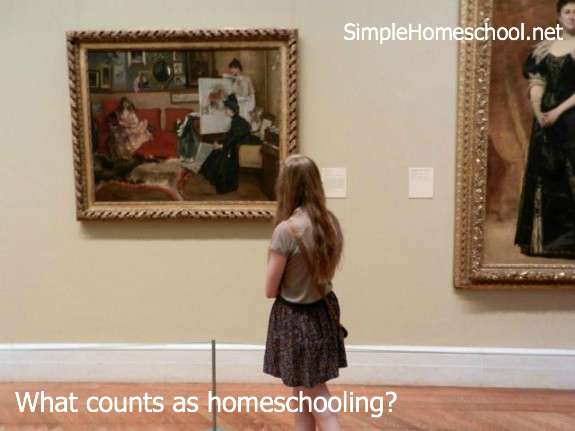
At a recent roundtable discussion organized by our homeschooling support group, a brand new homeschooling mom raised her hand and asked the perennial question: What counts as homeschooling?
I have heard the same questions dozens of times through the years: Can I count playing board games? Can I count hiking as PE? Can I count the afternoon we spent talking with a veteran about WWII? Can I count our trip to Washington DC? Yes, yes, seriously? and YES!
I know the question that is being asked. It comes from a deeply ingrained assumption that if it is school, it must be ___________ [boring, tedious, difficult, taxing, mind-numbing, repetitive—you choose]. For some reason, we feel that we must put an official stamp of approval on an activity in order for it to “count” as “school.”
At this point, a redefinition is necessary. Since most of us were public schoolers ourselves, we have trouble confusing the word “school” with its intention, “education.” Education is, at its core, developing the abilities of the mind: acquiring general knowledge and skills, developing clear thinking and good judgment, and ultimately working toward navigating in the world at a mature level.
Instead of asking ourselves “does this count as school?” we should be asking, “Is my child learning something worthwhile?”
Our job as educators is to be able to recognize what is worthwhile. Ask yourself if a particular activity serves to help your child acquire general knowledge and skills, or develop clear thinking or a new perspective in some way.
Did your six-year-old learn how to crack an egg into a bowl while you were baking cookies today? That is a skill that some adults haven’t yet mastered. Does your teenager lead devotions at youth group? She is learning organization and leadership skills that absolutely “count.”

Some use the mantra “learning happens all the time.” I’m not convinced that any learning goes on while a child is watching “Sponge Bob,” but the idea behind the mantra is valid.
The world is full of opportunities for learning new things. Seize them. That is what counts!
Some of us will need to mentally (or physically) check a box: museum field trip = history; letter-writing = language arts; going for a nature walk = science; finding and measuring every rectangle in the house = math. Don’t apologize if you need to keep track of these things in a formal manner. Some of us are wired that way.
If you have someone in your life who is skeptical that “learning happens all the time”—or if you are doubting yourself—try recording every little detail of your child’s daily life. Put each activity into a category (math, language arts, science, health, art, music, etc.). I think you’ll find that those things that seemed so un-school-like are, indeed, worthwhile learning opportunities.
As home-educators, we need to focus on the “worthwhile” part and not on the what-looks-like-school part.
We shouldn’t be teaching to the test; we should be teaching to the mind, to the heart, and to the soul.
Because that is what truly counts.
Do you have trouble deciding “what counts”? How do you define learning?

What subject woukd I count board games under? Like trouble, connect 4, sequence, etc.
Oh, yes. I live in a state that requires certain subjects. I’ve started writing down what we do just to make sure that if they ever ask, I can say, “Yup. Not every day, but here it is.” It’s been really helpful for me to sit down at the end of those days where we didn’t do much school type work and write down what we did do and assign a category, and think about how valuable it is. Playing outside as PE, kids telling me what they’ve figured out in math or reading signs, social skills when playing together or with friends, watching Wild Kratts, listening to the Narnia Chronicles on audio book in the van – it all counts. Playing in the mud pit is totally science. So is finding a dead snake on a walk. There’s really very little we do that doesn’t count. And when I write it down, it encourages me that the kids really are getting what they need. And much more than a lot of kids.
The idea of Always Learning is paramount. With a teacher-student ratio of 1:6 (all on different grade levels), I can’t be “teaching” everyone all the time. There are subjects that are mandatory each day (reading, math), but when I’m working one-on-one with someone, the others tend to putter about exploring, creating, experimenting and (most of the time) it’s all okay. It doesn’t look like the local school, but that’s one of the reasons they are at home.
The state of Wisconsin and others requires 875 hours logged per school year.So can I still count “everything” or do they mean 875 in only the “required” subjects?Alot of people including me seem confused by this.How would we find out.
You might be able to find out more if you look at hslda.org and check out their map of varying homeschool laws.
Since most schools in the US typically work with 180 day school year, 875 hours would break down to a little less than 5 hours per day. That would probably be for all subjects combined, so I think that gives you a lot of flexibility to create your own school day according to what suits you and yours! It doesn’t mean that you have to be doing lectures and academic assignments for that entire time.