Classical Conversations: An Introduction

Classical Conversations: An Introduction ~
Written by Heidi Scovel of Mt. Hope Chronicles
A note from Jamie: Take my quiz here to get personalized tips to help you organize your homeschool based on what your personality needs most!
****
For many families, homeschooling is a much broader reality than the designation implies. The variety of educational opportunities is steadily increasing along with the realization that school isn’t a one-size-fits-all proposition.
Tutoring groups, homeschool co-ops, community classes, umbrella schools, field trips, online classes — sometimes the sheer quantity of choices is staggering. And very often homeschooling families find themselves out of the home for one or more days each week.
After several years without outside commitments, my family chose to join a local CC community this year and found it a perfect fit for our needs. When I was first introduced to the program I had so many questions, and it took a while for me to decide whether it would be right for us.
Now that we’ve been participating for several months, I can say that it has been a wonderful opportunity for my boys. I would love to share some details about Classical Conversations.
Classical Conversations is a nation-wide program that helps train and equip parents to provide their children with a Christian classical education.
Individual communities hire parents to be trained as tutors through Classical Conversations practicums, who then lead small classes of children in weekly meetings.
A quick overview of Classical Conversations:
Foundations
For the grammar stage (grades K4-6th), the Foundations program meets for twenty-four weeks during the school year. The classes meet one morning each week for three hours. (Leaving plenty of time during the week as well as during the year for additional studies.)
During the morning classes, tutors introduce the students to memory work in history, science, geography, English grammar, Latin, math, Bible, and the history time line.
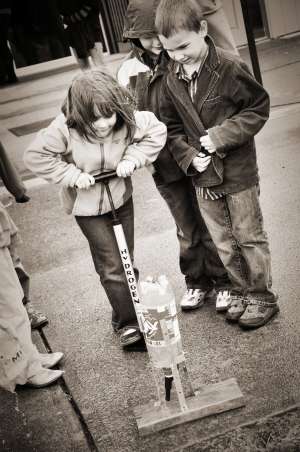
Each student gives a short presentation in front of their class to learn public speaking skills. Science experiments and four six-week fine arts studies (drawing, tin whistle/music theory, famous artists/art projects, and instruments of the orchestra/composers) complete the schedule.
Parents are required to attend classes with their children so that they observe and learn from the teaching modeled by the tutors, which will in turn help them guide their children in reviewing the memory work at home.
The memory work outlined in the Foundations classes is designed to prepare the students for the higher-level classes. CC recommends that parents teach phonics, math, and handwriting studies at home.
Essentials
Beginning in 4th grade, an afternoon session is available to supplement the Foundations classes through 6th grade.
During Essentials, students learn language arts and structure with The Essentials of the English Language Guide, writing through the Institute for Excellence in Writing programs, and math through challenging problems and games.
Challenge
Day-long (30-week) Challenge programs for logic and rhetoric stages begin in 7th grade.
These classes cover math, Latin and Spanish, literature and writing, science labs, debate, rhetoric, and geography (mapping the whole world free-hand from memory!).
Students complete lessons and assignments at home during the remainder of the week.
Why I decided that Classical Conversations would be right for my family:
After some time of deliberation, I had a list of benefits this program would provide for us.
- Consistency and discipline in memory work across all subjects.
- Outside accountability.
- A social network of families interested in the same educational philosophy and goals.
- Experience in a classroom situation.
- Opportunity to make new friends.
- Learning from other adults and mentors.
- Hands-on science and fine arts projects.
- Practice in public speaking.
What students memorize during the three year-long cycles of Foundations:
It felt like Christmas the day my Foundations Curriculum Guide came in the mail. I pored over it and felt my excitement growing. It contains all the memory work for all three cycles.
Every year, Foundations students memorize all of the Veritas Press History Timeline cards from ancient history to modern times. Students also memorize the U.S. presidents yearly.
Math memory work is also the same each cycle: skip counting numbers up to 15 and other math facts such as the formula for finding the area of a circle.
Students memorize an astonishing amount of geography (new material each cycle): not only countries but also mountains, bodies of water, deserts, the U.S. states and capitals, territories, and more! The students practice tracing and drawing maps.
Other memory work includes weekly history sentences (the 7 Wonders of the Ancient World, the Bill of Rights, Charlemagne), Latin (declensions, conjugations, and Bible translation), English (parts of speech, participles, irregular verb tenses, and clauses), and passages from the Bible.
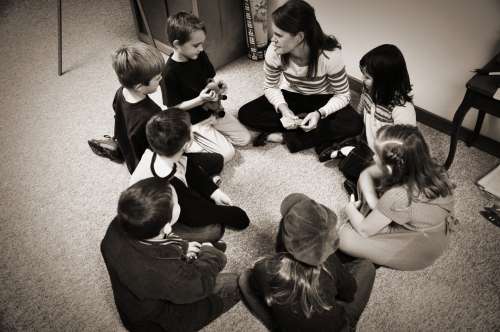
Each family has the flexibility of using the memory work however they wish during the week. We have used it as a spring-board for additional science and history reading and discovering, to solidify our math and grammar skills, and as a way of exploring our world through geography.
Further Links:
- The Case for Memorization by Stefani Austin at Simple Homeschool
- I share reasons why I value the memory work at my blog, Mt. Hope Chronicles.
- A peek inside our day at Classical Conversations classes.
Have you participated in outside classes or homeschool groups? Have you found the experience to be a positive one?
What’s Your Homeschool Mom Personality? Take Jamie’s quiz now and receive a free personality report to help you organize your homeschool based on what your personality type needs most!


Great overview! We absolutely love Classical Conversations and see it serving as the foundation for our girls’ education through the high school years.
Leigh Bortins’ newest book, The Core, really solidified my homeschooling philosophy for me. I highly recommend it for all parents, regardless of schooling choices!
I enjoyed reading The Core, too. I’m glad to hear you are having a good experience with CC, as well!
lovely post about a fantastic program. we too use and love classical conversations. thanks for providing an introduction i can recommend to curious family and friends.
Thank you for spotlighting this – I am looking into this for next year, and I’ve been kind of overwhelmed with the info – this told me exactly what I needed!
We just joined a CC group this year and LOVE it. My children have learned so much and look forward to attending every week. Best of all, my reluctant husband is now sold on homeschooling, after seeing how much my children learned there as opposed to how little they learned in public school (despite ten times as many hours spent at a desk). I’m glad to see the word spreading about this wonderful program! 🙂
We’re a homeschooling family….we’ve been part of CC for two years…I’m a tutor and love it!
Both of my boys do foundations and my oldest has been in essentials for both years that we’ve been involved.
I can’t say enough about it.
It has been the perfect fit for our family….
Thanks for the summary. We have a group that meets locally but I never really knew what it was about. Sounds like an interesting program.
This sounds fantastic! I am not homeschooling yet because my son is still too young, but I am planning on doing so. How can I find information about these types of programs in my area? I would totally be interested in being one of the tutors/teachers if this program doesnt already exist in my area
At the very top of the CC website (http://www.classicalconversations.com/) click on the blue US map to find the locations of communities in your area.
Well, yay about the geography. This is often an easily forgotten part of curriculum.
Thank u for info about a CC. Is that true that when a child starts a CC ( 1 year ) he may begin in the 2 or 3 cycle instead of 1 ? I have been considering it for my dd ( age 5), but I want to do the Story of the world in chronological order.
Thanks, Margarita
Yes, all CC communities do the same cycle each year. This next year all CC communities (all Foundations classes) will be doing cycle 1. The cycles do not match up perfectly with The Story of the World even if a child begins with cycle 1, though.
We have been doing CC for 4 years now and we love it. I love the like minded families that we meet with every week. Our oldest is in Challenge 1 so I get to see the benefit of Foundations on a regular basis. They are loving learning!
Hi Heidi, thanks for the super helpful post about CC! I’m starting a CC campus in Portland, OR and was wondering if I could have permission to use one of your pictures (the one with the paints on the table) for an advertising poster. Thanks!
This sounds great, and I think I might want to check it out, but I have a concern. This is our first year homeschooling and my son is a “5th grader”. Have we already missed out on being able to do this?
Certainly it is ideal to have a few years of Foundations and Essentials under a student’s belt before hitting the Challenge level, but you can jump in at any time! My sister started two of her children at the Challenge level, and they’ve done well. Even if your son starts CC next year as a 6th grader, he would still have a year to reap the benefits, particularly the history timeline in Foundations and all of the language arts in Essentials. There is a little bit of wiggle room for students entering the Challenge program. You may be able to wait a year (depending on the age cut-off) and have him do a second year of Foundations/Essentials if you feel he isn’t ready for Challenge–which is a fantastic program for many 7th-12th grade students.
I am praying that we can start a CC group in the rural area where I live next year. We still need someone to be the Director and probably at least one tutor.
I wrote this article three years ago, only a few months into our first year with CC. If anyone is wondering if we’ve stuck with it, we have! We are finishing up our fourth year of Foundations, our second year of Essentials, and my oldest son is headed into the Challenge program next year. I wrote an update with more detailed Classical Conversations information during our 3rd year. Not much has changed. 🙂 http://mthopeacademy.blogspot.com/2012/10/classical-conversations-our-3rd-year.html
Would you recommend starting an only child when he’s 4 years old? Is that too soon if there are no older siblings also in the coop?
I apologize for taking so long to answer this question! In my experience, I would hold out if my 4 year old was the oldest (particularly I would be hauling littles along each week). I really think this program shines for 1st grade and up. My 4 year old did well with some things (memorizing more than I thought he would, loving his tutor and classmates, singing the songs) and less well with some things (controlling his body and voice in a classroom setting and always being willing to participate). One’s experience would vary widely depending on the 4 year old!
I’ve been interested in CC, thank you so much for your explanation of how it works! I have a question. After the material for the week is memorized, is it practiced again after that, and if so, how often? Do you find that it sticks very well until the next year, when they repeat the same history memorization, for example?
In class, the tutors try to review 6 weeks of material at a time. At home, review is completely up to you and your preferences. My boys have done very well on the timeline and skip counting songs that are repeated every year. other material memorized does tend to fade a bit if we don’t review (the science and some of the English grammar is the most difficult to retain for us), but it comes back very quickly. This past year was our second time through cycle 2, and the boys had it much more quickly (and more permanently) this time around. That’s why it’s great to repeat the cycles of information! 🙂 The history sentences are probably the easiest to retain and the ones that come up most often in our general reading.
(“reviewed” is what I meant when I said “practiced”)
Thank you for this! It sounds wonderful and I am certainly interested – trying to plan ahead for our 4 year-old. One question, do you think it works well for those kiddos who respond best to an extremely interest-led style? My son can NOT be convinced to learn something he isn’t hugely interested in (though he will respectfully try, but it makes him quiet and sad), but he learns extreme amounts about what he does find interesting. When I pinpoint an interest we CAN use curriculums (so far, Montessori, lap books, and unit studies, ridiculous amounts of reading) to expand on that interest. CC sounds like such a wonderful program/process, but I’m trying to decide if he would just shut down during the parts that don’t click for him? Thanks in advance for any insight!
I’ve found in my experience that kids are much more interested in (and more capable of) learning the material when it is presented in the classroom format at CC. The weeks we’ve missed and tried to make up at home are much more difficult. It would depend on whether your son would enjoy the cooperative, social learning atmosphere with games and songs. Also, depending on the ages of my children, we’ve reviewed and used certain subjects more than others due to their interests and abilities. So it is certainly something you could tailor at home. Use the class time as an introduction to ideas and facts and then dig deeper into the parts that interest him during your week at home, for example.
Fantastic article! Its nice that you have shared
I was wondering if you could tell me, especially at the challenge levels- how much leg room is there for other curriculum? I have a program that we are really enjoying (my fathers world) and I really don’t want to drop it but I really want to enroll in CC classes. My concern is around the challenge and older levels when both programs seem to get more rigorous. Do you think it would be super intense amount of work or is there wiggle room for other curriculum?
That’s a good question, Michelle. There is a huge amount of wiggle room with Foundations (the morning program for kids 4-12), and only a little less so with the Essentials program (the afternoon program for kids 9-12). It changes quite a bit in the Challenge levels (roughly beginning in 7th grade). The Challenge levels are a complete curriculum. We do add music, sports, and church activities, but I would find it difficult to add much more than that. It obviously depends on the student. There are two things to remember, however: 1. The parent is still the teacher. The parent can reduce the amount of work for their student in one or all subjects (or drop a subject completely) and add (or not) other work or activities. 2. The Challenge year is only 30 weeks. Students are finished by the end of April, so May and June might be a time to add in different studies or activities. In general, though, Challenge should be considered a full curriculum. Hope that helps! 🙂
Thank you for this wonderful summary of CC. I’m considering it with my rising kindergartener, and was trying to understand what sort of supplements were involved outside of the structured class time. This was a great help. Every child I’ve met who has been through CC, even if only for Foundations, has been wonderfully confident, bright, and grounded. It certainly seems like a wonderful program.
Today is the first time hearing of this style. I am definitely intrigued and interested. I am new to homeschooling, this being our first year. My biggest concern is our late start. My kids are in 1st and 539th grade. How is the transition?
In your opinion, is it too late to start my children in a CC program? We have 5th, 3rd, and 1st grades.
I am interested in CC, and I know several people who are involved with CC, but I am a retired teacher. And, although I would love being involved with CC as a teacher, I find it rather depressing that One: you have to have children in CC in order to be involved and if you have no children of your own, you cannot be a teacher in CC. The mother is always the teacher and I have no school age children. That seems rather a narrow concept of education.
I know this is an older post but how are you liking cc? Did you stick with it? I’ve been reading the well trained mind and about cc I’m very interested in it for my children. They are not yet school age, but I’m trying to learn since time seems to fly!
I am totally new to even LOOKING into CC–and I am in my 21st year of homeschooling. The kids I would want to target for this would next year be in 7th and 10th grade, as well as a non-verbal/lower-functioning child–who is 9 but only learning some letters and numbers. Is there anyway to combine a lot of the stuff for all three? I work part-time–I cannot see this working well if I have to be spread between those three (as well as an adult disabled child living at home who operates at about a 5 year old level).
ANY suggestions are appreciated!
I think you have a strange typo:
“…the U.S. states and buy steroids online capitals, territories…”
buy steroids online?
What in the world happened there? Thought you would want to know.
Thanks for letting me know, Charlie!
Hi I’m trying to get ahold of someone to get more info my number 832-807-0392
Someone from Classical Conversations? If you haven’t yet, this form ought to connect you to whoever is over your area: https://www.classicalconversations.com/community-search/
Or if you’ve asked for info and haven’t been able to get in touch with anyone yet, let me know and I can give your number to my team so that they can get you connected 🙂
– Sarah from the Classical Conversations team
What if I have 4 children … does there have to be an adult/parent in every classroom?
Hello! I have 9 year old, 12 year old. I am considering the challenge program for my kids this next year. Neither of them have any experience in CC. My 12 year old just finished 6th grade in a private school. He is mostly A student with some high Bs. Should he do a year of foundations and essentials first and then go to the Challenge program or can he just jump into the Challenge program now?
Should the 9 year old do both Foundations and Essentials or just the Essentials his first year?
Thank you guys.
Would it be difficult for my children (ages 11 and 9) to start CC at their age?
They are public schooled.
Erica, do you mean that you plan to begin homeschooling them next year? If so, I would think that that could out well for you. I’d reach out directly to CC to ask for their opinion as well.