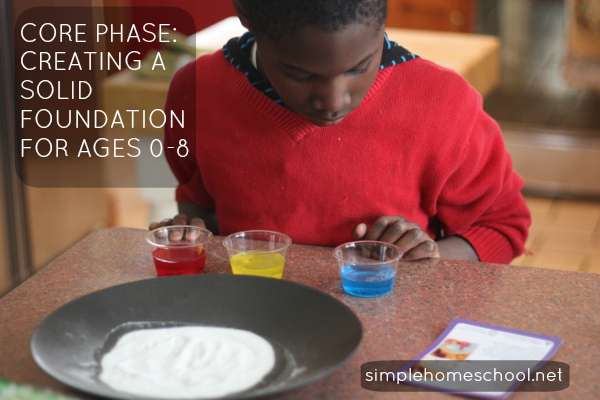
Core Phase: Creating a solid foundation for ages 0-8

Jamie C. Martin, editor of Simple Homeschool
This post is part of an ongoing series about the educational philosophy Leadership Education (also known as A Thomas Jefferson Education.)
“Core Phase is the basis of a life. A good Core Phase naturally provides the foundation for a good life, a great Core Phase for a great life, and so on.”
~ Oliver and Rachel DeMille, Leadership Education, page 40
Would you rather listen instead?
I stared at the desktop screen late one night, engrossed in a popular homeschooling forum where members could ask for help and receive advice. Someone had asked a question–I don’t even remember what it was–and one of the responses said something like this:
“I recommend you check out A Thomas Jefferson Education.”
It included a link to an overview of the method, which I clicked. Then, as sometimes happens in the midst of epiphanies, I sat up straighter as I began to read. In a flash of insight, I absolutely knew that this was part of what I was looking for in our homeschool.
The method combined the freedom of unschooling with a balance of structure, responsibility, and academic focus–especially in the teen years–that resonated with me.
Though my kids were all young at the time, I ordered every book I could find about it and began to internalize its principles. And it turns out I had plenty of time to focus on my own education–because all my kids were in Core Phase.
What is Core Phase?
Leadership Education divides childhood learning into four phases (head here for a short overview) and Core Phase is the first. It encompasses the initial eight or so years of a child’s life, the most impressionable and foundational time for all that follows.

“Solid inner core” – yes, that’s what we’re after! Image credit: NASA
If we envision the phases of learning as a planet, then core phase would be at the center of it all, each phase that comes later building on top of it. You can imagine, then, the vital importance of it being strong and solidly built.
Without it, nothing that comes after could last or grow.
“The tools for academic learning are present, as are the tools for cooking or making home repairs, and little children use them more in the context of tagging along or playing at the work of adults. There is no adult skill that children are obligated to master at this stage.”
~ Leadership Education, page 42
The curriculum for Core Phase
In core phase the “curriculum” is this:
- right and wrong
- true and false
- good and bad
- relationships
- faith and security
- family identity
- routines and responsibilities
- accountability (learned through the above, not through academics)
- the value and love of work and play
The first time I read this list I loved it. It whispered and confirmed to my soul the most important lessons in life.
You’ll notice that academics don’t appear on the list, and that is a deliberate omission. Parents work hard in Core Phase to create an inspiring atmosphere (following the seven keys of great teaching) that exposes their children to good and beautiful things, including academics. But children are not expected to master any of it until much later.
“When we give in appropriate attention to academic achievement…, it can teach our children that they dislike academics because everything is hard and boring, and/or offer our children an alternative sense of self-worth that is inferior to a genuine and positive self-concept resulting from living according to true values such as faith, good works and accountability.”
~ Leadership Education, page 41
I get emails regularly from worried homeschooling parents of young children under eight, complaining that all their kids want to do is play. But what if, in fact, that is exactly what young children are meant to be doing?
What if play is a child’s work and the inbuilt curiosity that God gave them the inner force they need to one day succeed in this world?

Voices in support of Core Phase:
“The first education should be the harmonious development of the child’s physical, mental and spiritual powers. Providing warm and understanding responses to your children’s ‘hearts’ accomplishes far more than pressuring book knowledge into their minds. ”
~ Raymond and Dorothy Moore, homeschooling pioneers and authors of Better Late Than Early
“…my object is to show that the chief function of the child–his business in the world during the first six or seven years of his life–is to find out all he can, about whatever comes under his notice, by means of his five senses…”
~ Charlotte Mason, 19th century British educator
“Our highest endeavor must be to develop free human beings who are able of themselves to impart purpose and direction to their lives. The need for imagination, a sense of truth, and a feeling of responsibility — these three forces are the very nerve of education.”
~ Rudolf Steiner, founder of Waldorf Education
“Children are, by nature and from birth, very curious about the world around them, and very energetic, resourceful and competent in exploring it, finding out about it, and mastering it. In short, much more eager to learn, and much better at learning than most adults.”
~ John Holt, founder of unschooling
“Education is a natural process carried out by the human individual, and is acquired not by listening to words, but by experiences in the environment.”
~ Maria Montessori, Italian physician and educator
To me, seeing such a wide variety of experts in their fields–philosophers, researchers, doctors, teachers–proclaiming the benefits of Core Phase in their generation is wildly comforting. It reminds me that this idea just makes sense–that actually institutionalized schooling is the latest educational experiment.
If they don’t play now, then when?
We have a crisis going on in our culture. We stop our young children from playing at the season in life when they should. Resentful and bitter–even on a subconscious level–not only does this often create a hate of learning, it also results in adults determined to “play” in other seasons of life where their behavior has more serious repercussions on their families, their children, and society as a whole.
Maybe a major “mid-life crisis” is nothing more than someone who lacked a secure core foundation as a child. One way or another, we will learn the core phase lessons of good and bad, right and wrong, true and false, but wouldn’t it be best to learn them in a way that doesn’t cause suffering to ourselves and others?
And if that is true, then maybe the best gift we could possibly give our young kids isn’t the earliest reading skills or math drills. Maybe their future happiness and success rests upon the foundation of the pyramid we allow them to build now–through play and work and natural learning in the midst of secure family life.

My experience
We have followed this educational philosophy since that very night when it appeared on my computer screen. Toddlers and preschoolers at the time, my kids have never known any another way. Trishna (10) and Jonathan (9) have now transitioned into the next learning phase. Elijah (8) has one foot still firmly in Core and is dipping his toes into the waters of the upcoming phase as well.
Two of my kids naturally learned to read during their Core Phase with plenty of modeling, discussion, and read-alouds. But there were few formal lessons in any subject to speak of, unless the children asked for them.
These core phase years–that seemed as though they would last forever–are almost entirely behind us. It has been downright scary at times to raise little ones in such a different way to the majority, but it’s also been incredibly freeing.
And for us, it’s been right.

If this intrigues you and you’d like to learn more, check out these resources:
- Tjed.org – the official site of A Thomas Jefferson Education
- A Thomas Jefferson Education by Oliver DeMille (This book explains the WHY of the method)
- Leadership Education: The Phases of Learning by Oliver and Rachel DeMille (My personal fav, this book explains the HOW)
What’s Your Homeschool Mom Personality? Take Jamie’s quiz now and receive a free personality report to help you organize your homeschool based on what your personality type needs most!
Jamie, thank you for this post and for introducing me to leadership education over a year ago through your SteadyMom blog! At that time, I was immersed in trying to use a Well-Trained Mind (WTM) to teach my (then 1st-grader) daughter. WTM is so very rigorous, and I had been mixing in some of Charlotte Mason’s ideas to tone things down some after finding it all to be too rigorous for my daughter.
Through your blog, I found TJED. Like you, once I started reading TJED, I started devouring all I could about it. It resonated deep within me, yet it still took a real leap of faith for me to jump off the rigorous classical model laid out in Well-Trained Mind. We are led to believe that rigorous education is so important for our young children, and it can be hard to go against that idea. But as I read TJED, I felt so strongly that the values/morals/responsibilities were what were easily left behind while I tried to teach my young daughter academics. How could I find the time to really teach my daughter to do her chores (taking care of the chickens) without complaining and to do her best, when I had already been cajoling her into doing school for several hours and wanted to let her play? Now with TJED, I get to focus on teaching her those oh-so-important things like how to be a good, responsible member of the family, and she is allowed so much more freedom and time to play and explore life as a 7-year-old.
And one thing that has shocked me the most through all of this is seeing that my daughter still learns tremendous amounts without me needing to push any of it. Our children really are wired to learn, they are made that way, and we do not need to push them to get them to learn. Pushing them just strips away their own desire and natural inclination to learn on their own. Through pushing my daughter at age 5, she was starting to dislike math and writing. Now through giving her freedom and a solid core phase, she loves math (Life of Fred rocks!!). As for writing, she doesn’t love it, but she also doesn’t hate it anymore like she did by the end of 2 years with forced schooling. I no longer force her to write anything, but I do encourage her to do so when opportunities arise. For instance, she collects and polishes rocks that she wants to sell. She asked me to write labels on the bags of rocks for her, but I mentioned that her customers would probably much prefer to see her own handwriting.
By the way, I also found Free to Learn (by Peter Gray) to be an inspiring, thought provoking look at children’s play and how important it is for them developmentally. It gave me even more confidence in my decision to not force schooling on my young children.
Thanks again Jamie!!
Sarah, what a great story! How lucky your daughter is to have a mom who trusts the light within, and who leads by inspiration!
Free to Learn is a GREAT read. Oliver wrote a review of it here: http://www.tjed.org/2013/06/secure-stressedapplied-children-youth-weekly-mentor/
I see that you’re a blogger – I hope you’re blogging your family education experiences – I feel that you’d be an inspiration to many! xoxo rd
Thanks Rachel! You and Oliver are such a wonderful source of inspiration and information. I love your blog/website and all the wonderful resources you provide that inspire me to focus on my own education.
I’m so glad that I found your information when I did. My 4-year-old son will get to have the benefit of never being forced into schooling at a young age as his sister was. He is so strong-willed it would have been a horrendous battle with him anyway, as getting him to do anything he doesn’t want to takes a lot of creative thinking. And yes, I do blog about our family’s educational experiences. This post talks about our shift into TJED for this school year: http://nourishedandnurtured.blogspot.com/2013/08/our-2013-14-homeschool-philosophy-and.html
Thank you again!!
Jamie, this is amazing. i have heard of Thomas Jefferson Education but have never quite understood what it actually is. It turns out, our homeschool has been modeling it without my even knowing it! My children who are 8 and under do not do formal math, although I do read Life of Fred to them as a story. They are all allowed to freely play, but they also have chores everyday. My kids between 9-13 complete the Life of Fred math problems, and I am more mindful of what they’re pursuing and will often make suggestions (via strewing or oral suggestions). My 14 year old has worked with me to create her own curriculum for next year (based on the show Sherlock), in which she will use living books, some textbooks- just because I couldn’t find many psychology living books with a Christian worldview- and media. This post has really helped me to feel more confident in our approach, especially when I read other posts where 5 year olds are learning Latin and 8 year olds cover so many individual subjects that they could probably earn a college degree with it. Thank you, thank you, thank you!
Shelly, wow, it sounds like you could have written the book! You’re a natural! xoxo rd
I’ve heard of TJED from this blog and FIMBY, and have their main book, but haven’t gotten around to reading it yet. I’d like to read it this year. Where I live (WA) kids aren’t required to attend/register/homeschool until they are 8. I couldn’t believe that! In my previous state in the midwest, they were required at 6. I can see a lot of benefits of this method but I think it would actually be hard to implement depending on your state’s laws.
I’m really looking forward to reading the rest of your series! I loved all the quotes stacked up next to each other.
Sarah M
Sarah, there are actually TJEders in virtually every state and all around the world. If you feel that it might be a fit for you, please do connect with us on our Discussion group: http://facebook.com/groups/tjeddiscussion/. There are lots of parents and mentors who are eager to help others navigate the particulars of the state you’re in.
I too found out about TJed through your posts on FB. Back in October we decided that this year would be our eldest daughter ‘s (9) last year in public schooling. We also have a 3y/o girl and 1 y/o boy. We poured through homeschooling blogs, Pinterest, articles and FB sites trying to find what philosophy best fit our needs. After about 2 mos of searching I found your FB site simple homeschooling and website and about month later you mentioned TJed.
It turned our homeschooling world right side up. It was everything my husband and I were looking for. I immediately downloaded the book and joined the FB group. The simple genius of the philosophy still blows me away. It’s now almost April and we are more confident that we’ve made the right choice for this fall. We’ve already started reading classics as a family and individually. I can’t express enough how grateful I am for you.
Desria, it is simple, and challenging, obvious and unexpected – all rolled into one!
I’m so glad I read this blog today. Its message is something I’ve been needing. I started homeschooling my seven year old daughter in this past October (2013) and its been a huge huge challenge. The love of learning is not there and I understand the philosophy of play as being fundamental for learning and development and I understand her not wanting to sit for hours at a time learning academics. The problem is I am pressured by the other parent, who I’m not with and who does not want her homeschooled, to show real “results” and have her tested at the end of a normal school year or she will have to go back to public school which she was miserable in. So everyday is a struggle to find a balance between the two methods and we fight and argue every. single. day. Which I hate. I don’t want to spend these precious years fighting with her and both of us being miserable. She is almost 8 now and I’m at a loss for what to do. I love this idea of a core phase but is it too late? Any advice would be helpful. I feel all alone in this journey and it’s very discouraging at times. I just know that I want the best for my baby and I want to homeschool. Thanks so much in advance!
Rebecca
I think sometimes remember that when you are teaching this way, often they can still be doing good on tests. You are just learning in a different way!
Rebecca, there are several articles (this one included!) that can be quite compelling for those who don’t “get” it. More and more of the most respected educators are chiming in to say that early academics and conveyor belt instruction are not in the interest of our children – not for their souls, not for their minds, not for the prospects for their future. You can get a free download of an article that might be of interest to your ex-partner(?), called “The Future of American Education: 8 Trends Every Parent Should Understand”. You can request it here: http://tjed.org/bonus-gifts/
Rachel, will you address the question that Rebecca posed: “Is it too late?” I also have a 7 year old that fights me to do school so I would love to adopt this philosophy. I also have an 8 year old that is still in public school that I want to pull out next year. Would I go back to the core phase with him or move on to the next phase right away? Thanks in advance for your help.
Tiffany, the short answer to your question is that you would go back to core phase with him and allow him to relearn any of the lessons he may have missed, and then he would naturally move on to Love of Learning phase when ready. The book Leadership Education speaks to this process in more detail, but it is most definitely not too late!!
Wow! Great post! My kids are past those ages, but this is one I would pass on!
Martha, it’s my understanding that Jamie’s planning on other posts that relate more specifically to other-aged kids, so stay tuned! Meanwhile, you can explore the phases that build on Core here: http://www.tjed.org/2011/06/homeschooling-excellence-phases-learning/
Jamie,
Thank you for this post. I am in my first year of Homeschooling, and we live FL which requires yearly portfolio reviews or evaluations starting at age 6. Is it possible to follow this method, and also be accountable with yearly reviews?
Thanks,
Jenny
Jennifer, Jamie is traveling today and asked me to make myself available to those who might have questions. The short answer is, “Yes!” There are TJEders in Florida, in most other states, and around the world. Our Facebook Discussion group often deals with questions such as this, with parents and mentors living in the particular state in question providing insights on how to effectively navigate state regulation/oversight, while serving the best interests of your children and aspiring to your highest ideals. Please feel free to join us! http://facebook.com/groups/tjeddiscussion/
I love your blog! It is full of such great inspiration to me! I have been reading lots of your blogs talking about TJed and have a friend who was very excited about TJed. And I am intrigued by it! From what I have read it makes a lot of sense! My question is what do you do if you have older kids who have never gone through the other phases? I have a 12 year old a ten year an 8 year old and a 6 year old. My two oldest went to public school till 3rd and 2nd grade and my youngest son went to kindergarten. My daughter who is 6 has only been homeschooled. We have done a more rigid homeschool the last few years which I like but it isn’t flowing with my kids and though I like the curriculum it’s more about checking the box. So we have decided to head down the slight unschooling road, we need to be a little more free and relaxed. I want to explore a little more and figure out what they are interested in. But how do you figure out what stage your child should be in if you are starting way later in the game? Obviously the 6 year old is still able to be in the core phase, but the rest are not. Any advice you have would be great! Thanks for this blog and all the encouragement you give us homeschoolers!
Bobbi, Jamie is traveling today and asked me to make myself available to those who had specific questions. I’m Rachel DeMille, the co-author of the TJEd educational model. As you might expect, there’s no two-word answer to your question (is anything every that simple in parenting???), but it’s a common one, nonetheless. And the mid-length answer is this: many, many families are successfully starting out, bringing whatever their mixed bag is right along with them, and renegotiating missed lessons of passed phases, to then progress and thrive! The book that Jamie praised above as her favorite TJEd work is probably the one most relevant to your question: Leadership Education: The Phases of Learning. A free sample download is available here: http://store.tjed.org/product/books/leadership-education/paperback
“The method combined the freedom of unschooling with a balance of structure, responsibility, and academic focus–especially in the teen years–that resonated with me.” I love this line. I love the idea of unschooling, but wonder if it would be structured enough for me, not my daughter lol. This may be something to explore, of course I have time; she’s only 8 months old!
Beth, that was my favorite line, too!! You’re lucky, and wise, to be exploring your options early! In my experience, the most important element that governs success in family education is the mindset, preparation and current level of inspiration that the parents bring to each day. You have time to really lead out, and have a deep well of meaning and experience to draw from as your baby’s needs and demands evolve from basic cares to deep philosophical questions!
Jamie,
I am so happy to see this post today. I love your writing and have followed your blog(s) for several years. It seems that each time I find my self rolling thoughts (or doubts) around in my mind, there appears the perfect encouraging post from you. My children are very young (3 and 5) but Leadership Education definitely speaks to me. And the more I read and learn about it, the more right that path feels. You are providing such an amazing resource for families just starting out, a true mentor. Certainly, this mentoring can take many forms, in this case, the virtual form. Well, that was the long version of “Thank you for what you do”.
Thank you so much, Kelly. I have been blessed with many virtual mentors as well that have just changed my life. The right words at the right time mean so much, don’t they?
Wow, this is really great information. This is my first year homeschooling my 8 year old daughter, and I fear we have missed the opportunity for the core phase. She attended (and was miserable in) a very rigid, overly academic school for first grade and has had my floundering, inexperienced homeschooling this year. I fear I’ve pushed her too hard, I’ve been so afraid of losing ground academically. It is so hard to step back and do things the way Jamie describes here (at least for me it is) yet it makes so much sense. I look at the curriculum list for the core phase, and I realize that my daughter has not mastered all of these things, despite being academically advanced.
I am really looking forward to the rest of this series. I hope there will be some advice on how to move towards more of a TJed model with older kids who didn’t get the benefit of this in their early years. Thanks for such a thoughtful, challenging article!
Katie, it is DEFINITELY not too late for an 8 year old. I understand the desire to “get ahead,” especially with a gifted or precocious child. But we have to ask ourselves: Are we actually getting ahead? Or is it a hurry-up-and-wait? Or a getting-completely-off-track? I’ve seen both of those far too often in families with the very best of intentions who start off fast and hard. Here’s a quote from my article on the Phases of Learning that sort of puts it all in perspective:
“Some of the greatest researchers in childhood behavior (Jean Piaget, Erik Erikson, and Dr. Raymond and Dorothy Moore) agree that children pushed academically at an early age tend to burn out early in adulthood, or long before.
“Young children do soak up learning like a sponge, but at what cost are children pushed into academic work too soon?
“A hate of learning is developed when children are forced to perform at a young age and blooms precisely at the time when non-pressured young minds have the potential to be the most curious and inquisitive!
“And if children of a very young age soak up knowledge so easily, shouldn’t they be learning the most important lessons of love, work, and faith during their most formative years, rather than filling their heads with random facts and figures their minds are unable to yet comprehend?
“By contrast, when a young person enters youth with a passion for learning and an increased level of emotional and neurological maturity, they can study long, hard and effectively with a deep sense of purpose.
“They are able to make and keep commitments with an inner drive to excel.
How sad it is when we push little ones to the point of emotional exhaustion, and then expect not nearly enough from our teens. It’s absolutely backwards!”
I have 8 kids – aged 23 down to 8 – and I can attest, by my own experience, and by observing the success of thousands of families we’ve consulted with, that the very best way to ensure academic excellence is by schooling the whole child, trusting each phase of development and its essential lessons to be a complementary part of a great whole. You can read the rest of the article cited here: http://www.tjed.org/2011/06/homeschooling-excellence-phases-learning/
Please note that it’s also a veritable rabbit trail of links to other related information.
And please, don’t stress it! You’re the kind of mom who’s going to do whatever it takes to do what’s best for your girl – even if that means slowing down and getting out of your comfort zone! You got this! xoox rd
Katie, if you read the book Leadership Education, it gives advice about how to walk through taking a child back through a phase that they may have missed. It can be done and wouldn’t be too complicated with a child your daughter’s age, so don’t worry!
As always, Jamie, you express difficult concepts in such a simple, beautiful and inspiring way. You and TJEd have changed our homeschooling journey completely, and dare I say it, us too! Thank you.
So blessed to hear this, Bronwyn. You’re so welcome!
I am so excited to learn more about this. I am having troube getting my hands on a copy of Leadership Education here in Canada, but have really been wanting to read it, so this will be great.
Emily, if you’ll use the contact form at tjed.org I can help hook you up with LE in Canada!
Best, rd
I’m so glad you wrote more about this. I’m a reader who has looked into this, but haven’t been completely clear on what I would be buying if I purchased the books. Now that I see this post (such a great explanation), I have a question for you: I have young kids (under 6) and am a reader of John Holt and Peter Gray among others. I am comfortable with the idea of unschooling and am totally on board with just playing and reading and looking things up when interested and cooking together etc etc until 8 or whenever. So I’m wondering if these books are going to present any new information for someone like me or is it just a different approach to conveying the many different ways we naturally come by education in our world? I hope that was a clear question! I can’t seem to determine what, if anything, might be helpful for someone already in this mindset from reading their website. Thoughts?
I see what you mean, Kelli. I’ve read tons from Holt and Gray as well and really love their books too. I think for me I get a lot of encouragement in the WHY department from reading them–why it’s important for kids to learn through play–that sort of thing. But from the DeMilles and Leadership Education (the book) I got a lot more of my questions about the HOWs answered, like “How can I practically create an environment and atmosphere in our home that sets us up well for this learning lifestyle?” And for me I find I go through seasons of ups and downs, when a new book even along the same lines from a different author is a welcome read. Hope that helps!
I also like TJED materials because it explains or focuses more on mentoring in a family. It is family centered, more than the other things u mentioned. It will also explain more about scholar phase.
LOVE this post Jamie!
This is now the post I refer all homeschool inquirers to, along with your ebook, which is fantastic.
We’ve always homeschooled, and I have been a part of an amazing TJed commonwealth for the past 3 years, and we LOVE it. The oldest of my seven children just started moving out of Core Phase around her 8th birthday last May, and I am already seeing hints that my 7 year old will be moving that direction this year also (she will be 8 this May). It is so wonderfully encouraging to see that they actually DO want to learn and grow without me pressuring them to do so, and in spite of all my perceived inadequacies.
I love this! I read the book Leadership Education two years ago and have it scheduled to re-read this year as well as any other books I can find on the subject. I, too, found that this philosophy seemed to be what I leaned to. I have done a LOT of reading on multiple philosophies and I continually gravitate toward this one. I’m a little nervous, but hoping I can move forward confidently with this approach. My kids are all in Core phase (or toddlers and babies 🙂 ), and I would love to know more about how others inspire during this phase and how you set up routines so even though they are playing there is also structure to our days. I have one child that really struggles with transitions and her therapist has recommended that we have a visual schedule to follow to help. I am trying to figure out how to keep adequate structure without it seeming too formal.
Thank you for this! I am looking forward to reading more. I have a 13 yo and a 11 yo, so I would love to see what a a typical day might look from them from a TJed standpoint.
Yep this is basically what I am doing. I don’t worry that I have to clean, cook and grocery shop because I know that my daughter can either help or she can play, do artwork, or whatever she wants. The major thing is to keep the tv off and keep plenty activities for them to do instead. Then take time out of each day to engage in something of their interest.
My husband likes to describe it as “limiting distractions”. Our kids have no TV, limited computer use and no other electronics. They are always engaged in reading, play, projects, household duties/learning, outdoor play, etc. They are constantly learning, even when they don’t know it!
This is extremely useful, You are an far too qualified tumblr. I’ve joined your current supply and check in advance to be able to searching for extra of this wonderful write-up. On top of that, I’ve discussed your internet site in my social networks
Montessori talks about self directed, play, project, and leader learning. She explains it as the rest of us experience it, a cyclical thing. Over and over again. My largest concern with core focus is that it can foster insecurity in teacher/parents that they are missing it or part of it. And for the child that if they missed something it is gone never to return.
Jamie, every time I feel like a big failure at Homeschooling, you seem to write the most timely and encouraging post. Thank you!!!
I am so grateful to you for this post and this site. You are forever widening and strengthening my non-traditional approach when I least expect it. Thank you from the bottom of my heart. And I’m sure my kids would thank you too if they knew you. 😉
I also resonate with this approach. I’d love to know HOW families teach the core phase curriculum. I’m finding that my three year old is ready for and needs direction in character development, doing chores, and so on. What methods do you use to teach these things? Do you think of skills you want your children to have and then try to intentionally work on them, or does it come more naturally?
We have been doing oak meadow and all about reading for the past 2 years. I am considering changing it up this year just because my kids have lost interest, or maybe gotten bored. Thinking about switching . Do you prefer one over the other?
I am very interested in this method, but my concern is that we live in a state that requires homeschoolers to do reviews twice a year. They look for coverage of all the typical academic subjects and proof of it too. Is there anyone who is in a similar situation that could offer advice? Thank you!
Thanks to Jamie for sending me here. So, I have a strong willed kinda pessimistic often angry 9.5 year old (and a 6 year who is the opposite ). 9 year old is about 2nd grade reading level. It’s so very very hard. She really dislikes writing (the physical part of it, not the creative) and reading….really anything ‘schooly’ she resists. Where would we start? I never expected homeschooling to have such misery (for both of us ), but I still think p.s. will have more negatives.
Question being….she’s older than 8…. she really really really hates ‘no’. She wants to direct her own path….
I am new to homeschooling as my oldest is just turning five and I’m just starting to look into it. While this sounds awesome and ideal I’m not sure how it fits/works in every state? For example I was found that our state (VA) requires an end of year assessment each year in order to “allow” me to homeschool. So even if I wanted to use this method I couldn’t really as I would have to teach sufficient information for my kids to pass the assessments…..Am I missing something? Thanks!
Thank u for writing this. I needed a second witness today. I’m a TJED follower or seeker. I try to learn and implement as much as possible. It’s a journey..a conversion process. My 6 year old is saying I don’t like table time I just want to read and play..he means me read to him. I was praying about this when I read your post. Wow!…support to let him play.
So glad to provide a little encouragement for you, Lauri.
A wonderful review of the Thomas Jefferson Education! We have been following and applying Oliver Demille’s teaching for several years now. Since we had the opportunity to hear him speak at a leadership conference. I am constantly encouraging other homeschoolers to consider the WHY of education more than the how and to inspire, inspire,inspire. I have the 7 keys posted on my refrigerator and review them many, many times a day!
What is your recommendation if you’ve missed the time to do this Core phase? I’m pretty crushed about it! I wanted to homeschool when my son went to K but was working and couldn’t swing it. He’s in second now, turning 8 in November and I’m growing very tired of the thousands of worksheets that come home and I know they are teaching to the upcoming tests, not necessarily what is pertinent. im not working now and would like to start with 3rd grade (equivalent, I guess). In the meantime I will read up in the TJ method-it sounds perfect!
I’ve missed this oh so important phase, what do I do next? Any advice is appreciated. Thanks so much!
Don’t worry one bit, Amy! It is VERY common to need to renegotiate one of the phases of learning–two of my three children have needed to do so as well. Basically you do so by just going back to that phase temporarily, no matter what the child’s age is. If you begin researching TJEd you’ll find a lot of information about just what that looks like. You can totally do this! xo