Lessons learned from Little House
~ Written by Jamie C. Martin, editor of Simple Homeschool
After several months, my three kids and I recently finished reading all nine books of the Little House on the Prairie series by Laura Ingalls Wilder. Reading these to my own kids was like a dream come true.
I fell in love with Laura and her life as a young girl myself and have read through the whole series three or four times. But experiencing them as an adult with children of my own gave me a new perspective than I had before.
Certain parts made me laugh, some parts made me cry, a few parts shocked me, and I took away a few lessons to remember as well.
Lessons learned from Little House
1. Self-reliance and industry are vital to family life.
 We made apple turnovers, like Almanzo took to school, after finishing the book Farmer Boy
Pa might hunt alone all day in the bitter cold, in the Big Woods covered with snow, and come home at night with nothing for Ma and Mary and Laura to eat. So as much food as possible must be stored away in the little house before winter came.
~ Little House in the Big Woods, Chapter 1
The survival aspect of Little House draws many of us into the Ingalls’ life story. It’s so far removed from our own lifestyles that it sounds like an adventure.
Our generation has been given a gift–the gift of leisure–that pioneers didn’t have. How are we investing that leisure time–giving it to hours in front of the television or computer–or dedicating it to our families, our education, and our life mission?
Freedom and purpose emerge through self-reliance and industry. Though there are certain things I hope never to do–like cook a pig’s head, for example–there are other skills I want to do myself and teach my children.
As homeschoolers, we have time to invest into teaching our kids these skills. Laura would be proud.
2. Atmosphere matters.
 No that’s not Laura’s cabin, but actually the 200-year-old farmhouse my family currently lives in. Photo by Desirea Rodgers
“What will Pa and Ma say?” Carrie quavered.
“We’ll know when they say it,” said Laura. “They won’t blame you, this isn’t your fault. It’s my fault because I rocked that seat so hard. I’m glad of it!” she added. “I’d do it again!” Carrie did not care whose fault it was. There is no comfort anywhere for anyone who dreads to go home.
~ Little Town on the Prairie, Sent Home from School
I was struck by Carrie’s insight in this passage: “There is no comfort anywhere for anyone who dreads to go home.” How true.
Laura and her family lived through severe ups and downs, yet an atmosphere of togetherness generally characterized her home–patience, family unity, and contentment.
As homeschooling families, we find a lesson in this–the atmosphere we create with our words, our tones, our smiles (or lack thereof) influences our family in profound ways.
3. A little (education) goes a long way.
 Photo by Desirea Rodgers
Laura almost wailed, “Oh, Ma! How can I ever teach school and help send Mary to college? How can I ever amount to anything when I can get only one day of school at a time?”
“Now, Laura,” Ma said kindly. “You must not be so easily discouraged. We will hurry and get the work done, then you can study. There is enough figuring in your arithmetic to keep you busy for a good many days, and you can do as much of it as you want to. Nothing keeps you from learning.”
~ The Long Winter, No Trains
Ma dreamed that her children would receive formal schooling. But for years and years, it didn’t happen.
Laura and Mary spent most of their childhood working with the family and playing on the prairie. In reality, they were homeschooled for most of their young lives.
When they finally went to school for a couple of years, they soared to the top of their class. Not only that, both girls demonstrated a passion for self-education, spending hours at home learning by lamplight.
Mary continued her studies, even after she became blind. Laura continued studying even after she became a teacher herself.
4. Keep calm and carry on.
 Photo by Desirea Rodgers
Ma sighed gently and said, “A whole year gone, Charles.” But Pa answered, cheerfully: “What’s a year amount to? We have all the time there is.”
~ Little House on the Prairie, Soldiers
The Ingalls family endured severe setbacks–loss of homesteads, debt, sickness, and death. But they continuously demonstrated a calm and grateful spirit, even in the face of tragedy.
I’m fascinated by their example, for as I write in my e-book Mindset for Moms, our reaction to life ultimately influences our circumstances themselves. Our perspectives matter.
Two of Ma’s upbeat sayings have become phrases around our home as well: “All’s well that ends well,” and “There’s no great loss without some small gain.”
5. There’s always room for improvement.
 Rocky Ridge Farm, where Laura and Almanzo lived in Missouri and where Laura wrote her books
“Why don’t you like Indians, Ma?” Laura asked.
“I just don’t like them, and don’t lick your fingers, Laura,” said Ma.
“This is Indian country, isn’t it?” Laura said. “What did we come to their country for, if you don’t like them?”
Ma said she didn’t know whether this was Indian country or not. She didn’t know where the Kansas line was. But whether or no, the Indians would not be here long.
~ Little House on the Prairie, Prairie Day
Hmmm. As an adult, I had a different reaction to some of these passages than I remember noticing as a child. I found myself editing a lot as I read-aloud. Some passages I’m surprised haven’t been removed or altered in subsequent printings.
Other parts I skipped touched on the harshness pioneers truthfully experienced, but that I wasn’t yet comfortable sharing with my kids. “Mommy, what’s a massacre?” wasn’t a question I wanted to tackle just yet.
But real life is like that, isn’t it? Imperfect, like we all are, reflecting both the highs and the lows of the cultures we’re raised in.
Several years ago, when Steve and I were moving cross-country, we chose to drive through Missouri so I could visit Laura and Almanzo’s home where she spent the majority of her life, and where she wrote her stories. (Did you know she didn’t even begin writing until the age of 65?!)
I stared in awe at Pa’s fiddle, sat on Laura’s porch, and stood by her grave as well. Like thousands of other Americans, I remain thankful for Laura’s words that have allowed this historical period to come to life for so many readers.
These stories capture our imaginations because they represent what we all desperately want: courage to keep trying in the face of resistance, wonder and desire to have an adventure, and the hope to believe that something better is sure to be just around the corner.
Little House Resources:
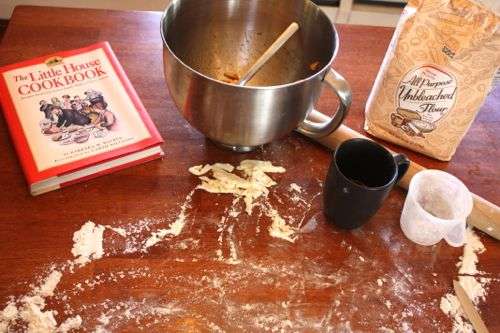
- The Complete Little House 9-book set
- The Little House Cookbook
- The Little House Guidebook
- My Little House Crafts Book
- Laura Ingalls Wilder Historical Timeline
Have you read the Little House books to your children? What lessons stuck out to you?

My dad took my sister and I to the house in Pepin once. He told us that it actually used to be on the other side of the road though. I can’t remember whether it was moved or something else but I do remember him telling us that. It was neat to see at the time, especially since I was kind of big into the whole Little House on the Prairie thing back then.
It definitely is interesting to see what we take so easily for granted. Things like more than two or three sets of clothing and more than two pairs of shoes were for rich people, not people like the Ingalls.
I love the Little House books too. They are very inspiring.
I too however have no desire to cook a pig’s head though. It is so funny you mention that too, because our Walmart (in China) had a bunch of them the other night and my husband jokingly asked if we should get one. The very thought was making my pregnant stomach turn cartwheels.
Hilarious, Anna!
I am just starting Little House in the Big Woods with my kids. It is really exciting. I never read them growing up, but did watch the tv show quite a bit. I really love American History, and especially this time period (which is probably why I love the PBS show Frontier House so much). It will be interesting to journey through the stories with my kids, and see what we learn.
I definitely agree that we need to have more self-reliance and industry in our families. We don’t always have the option to run out to the store and buy what we need, and teaching our children that we can put up food for the winter is a great starter. It makes me wish that I had paid more attention when my mom kept a large garden as I was growing up.
I loved Frontier House, too, though I hope the real pioneers got along better than that! 😉
Music played such an important role in the Ingalls’ lives. As Dale Cockrell (a music professor from Vanderbilt University) says, “…it’s ‘Pa’s fiddle,’ carefully wrapped, stowed in its fiddle-box, and cushioned by pillows, that accompanies the Ingalls family through all its adventures and comes to symbolize the endurance of the family unit in an often wild and threatening frontier world. Indeed, Wilder wrote to her publisher that ‘(t)here is one thing that will always remain the same to remind people of little Laura’s days on the prairie, and that is Pa’s fiddle.'”
So if you are like me and my girls, who wondered about the songs Pa played and the music they loved, you’re in luck. Dale Cockrell initiated what he calls Pa’s Fiddle Project, and compiled CDs with that music on it. You can read my post about it to learn more.
http://thickandthinthings.blogspot.com/2011/01/pas-fiddle-project.html
What a neat post to write about what you learned from Little House. I remember reading the books with my girls, but The Long Winter stands out the most to me. I can’t imagine the type of hardship they suffered that year never knowing when the next snowstorm would come. We have it SO easy compared to them.
The Long Winter stood out to me too! The circumstances were horrendous, but what courage Almanzo and all the others had! Reading it as a mother, I notice Ma’s attitude so much now–her steady patience and determination to be cheerful despite all the stress and fighting for survival. No meltdowns from Ma!
My parents read these books to us as kids and I’m looking forward to reading them to my kids as well. I love Carrie’s line, and hope my children always find comfort in coming home.
We did a unit study of Little house and living as a pioneer last year. We had even planned a trip out west. I have always loved this series and like you when I read it to the twins as a mom it took on a whole new meaning of how they lived.
Also as a mother I have a greater appreciation for Caroline Ingalls. I consider her the Ultimate Crunchy Homeschool Mama. She’s inspired me to enjoy what I have by living simply, teach my children at home, and even through adversity you are stronger than you think. Great post Jamie!
I have read the Little House books over and over with my kids through the years. I love the family togetherness that both the Ingalls and the Wilder families enjoyed. They worked hard together and this built their family bond. This is a concept I try to teach my children.
I grew up with the Little House cookbook, and although we (still) haven’t made every recipe, it is really fun to read the stories and make the food they would have been eating.
We love the cookbook, too – a great learning resource, even without the cooking!
I can’t wait til my kids are old enough for me to read these books to them! I loved them so as a child (and even as an adult), and I hope my littles ones love them too. Thanks for linking the great resources!
We camped out at the homestead in DeSmet, SD, two summers ago with our toddler and it was amazing to sleep on the prairie where the Ingalls family lived and visit the town they helped build. Waking up to the prairie breeze rippling the tent, driving by the lake where Laura and Almanzo courted, and meeting the friendly people of that small town was so worth it. One of the baby shower gifts my son received was a full set of the books, and I’m so thankful. 🙂 Thanks for sharing today!
Sounds like an amazing experience, Jo!
These are our family’s favorite series! I was inspired by the simplicity of Laura and Mary’s childhood, as well as their family values and skills, and wrote about it in ‘Childhood Simplicity – Little House Style’. We have done several free “Homeschoolshare” lapbooks and notebooks, which my children treasure and love to look through years later.
I read “Little House in the Big Woods” to my son last summer and he absolutely loved it! There are so many resources and books with activities to go with the Little House books that it can be overwhelming (just google Little House or Laura Ingalls Wilder).
We had fun making Laura’s Little Maple Cakes:
http://cuttingcouponsinkc.blogspot.com/2010/08/lauras-little-maple-cakes.html
My son has been begging to read more Little House books so I am planning to read more this summer.
We have read the books aloud to the children. I love them! Recently, my girls have been reading the Little House Books to themselves. And they have brought them up in conversation and applying what they have read. I have been so impressed and thankful for the books again.
I am thankful for Laura Ingalls Wilder’s glimpse into the pioneering life.
I’ve read the series to my older kids and am currently reading through it with my youngest. I agree that we can glean much from the books. I dislike the racism in the series and, like you, edit as I see fit. My daughter is 6 and I don’t want her hearing that kind of disrespect for other people groups.
Like you I devoured the entire series as a kid and am loving reading this not only to my kids but husband as well, we are all loving it. We are currently on the third book “Farmer Boy”. I also found myself editing passages from “Little House on the Prairie”. I also found myself editing passages from “Little House on the Prairie”. Part of me thinks well, this is how it was and my kids should know that this attitude is unacceptable and on the other hand, since they don’t even have that kind of idea in their realm of consciousness why on earth would I introduce it to them. It also happens that the area where we live is in fact a very large and vibrant First Nations community (Indian Territory) . Thank you for including the link Kika.
Link doesn’t work:( You need a password
I have read 3 of the books so far to my kids. My oldest (in grade 2) has developed such a love for the “pioneer days” from them. We are in Canada so this has evolved into pioneer life in Canada and then learning about a couple of famous local pioneers and First Nations (Native American) history. We’ve made pioneer food, played games like pioneer kids played and she has learned to embroider. It’s been such an amazing learning experience for everyone and such a fantastic platform for jumping off of.
I have been looking forward to the day my daughter is old enough to enjoy the Little House books with me, but your adult perspective reminds me that something can always be gleaned from a new perspective. Maybe I’ll go ahead and reread them myself while I wait to enjoy them with her – and perhaps I’ll be more prepared for which parts I’d like to discuss in specific detail with her.
My older daughter is named Laura Elizabeth after Laura Ingalls Wilder. There’s just something about Laura’s spirit that has resonated with me all my life. I treasured the stories as a child and as an adult, and I couldn’t wait to share them with my children. We read Little House In The Big Woods together last year and churned butter, made bread, and a played with a pig’s bladder (aka: origami water balloon).
Yes, there are some questionable topics and views in these books. As parents, I think we need to read unaltered accounts of historical events such as these to our children (appropriate to their age and understanding). These topics may not be PC now, but they are a more true reflection of the times that were and are great jumping off points for discussions now.
I love hearing how Little House has influenced you, Fran! I agree about the discussion point of view; I’m sure my kids will read the series on their own at some point and we’ll get to talk about all of that–at a time more developmentally appropriate to them.
I have always loved the book series, read it numerous times as a child. Although we never read the set while homeschooling, my kids read the series on their own. I even loved the TV series growing up! It is eye-opening to compare their REAL life to ours in the 21st century.
Great lessons you gleaned!
We love these and have 2 more to go, but we listen on CD to get through them faster so we can listen in the car or whatever. The recordings by Cherry Jones are fabulous.
My favorite Ma saying, “What must be done is best done cheerfully.”
Also, if you live near the Kansas/Oklahoma line, there is a Little House on the actual land where the original was and a Prairie Days Festival sometime in the summer. It’s great! HEre’s the link for more info about that: http://www.littlehouseontheprairiemuseum.com/Little_House_on_the_Prairie_Museum/Little_House_on_the_Prairie_Museum.html
I am currently in the middle of the series with my two children. (On the Banks of Plum Creek) I remember my 4th grade teacher reading this series to us just after lunch each day. I remember longing for her to keep reading and feeling sad when reading time was over. This is much the same reaction my daughter has when I read to them…my son (6yrs) is not one to sit and listen as much, but he makes it through them. We are about to plant our own garden so they can see how fulfilling it is to harvest a “crop” and prepare for the winter to come…Thank you for posting this…
I just started reading the series with my daughter and I’m loving it! It was very fun to read this post. Thanks!
It’s so nice to hear that other mom’s that have a “thing” for little house! My passion for Laura and the whole Ingalls family has always given friends and family reason for a bit of friendly teasing. Yes, I love these books… And they make it into my conversation a little too frequently, perhaps. I have had such hopes to make a trek through the Midwest with my family to see all these sites, yet I stopped planning when it occurred to me that I might be disappointed in what I find there now. There are no more “big woods” of Wisconsin, and it seems that much of these areas are practically unrecognizable from Laura’s days. And might the tourist sites have become “kitchy” ( is that the right word?) and cheapen my ideals a bit? I don’t know… Part of me would love to go, and another part wants to let it live in my mind untouched. Has anyone been and kind of wished they had not?
Regarding some of the difficult parts of the books… The parts I skipped over for my 9 year old were rare. I can only think of the part where they refer to the “hanging” in By the Shores… I can’t bridge that yet. ( oi… Humanity has such awful scars to bear witness to…) Ma’s racism reminds me so much of my own beloved Granny, who I loved to the depths of my being even knowing at a young age how wrong her views were in this respect. My kids have been raised with stories of my granny, including my horror at her rascist beliefs. And somehow I like that they have learned that we can deeply love people who’s views we consider wrong. It has given us reason to discuss how a persons life can impact their thoughts and behaviors. anyway, just had to pipe in here about my favorite topic in the whole world!!
Thanks for the post!
We’re reading through the series now with my 9 year old, and I was struck by Pa’s saying (in Little House on Plum Creek): “What must be done, is best done cheerfully.” I wrote it on the whiteboard in my kitchen, to remind me!
I’m grateful that sections of the book haven’t been “edited out” in the modern day. I don’t like the n-word, but I don’t think it should’ve been removed from printings of Huckleberry Finn. These are important parts of these books. Perhaps not parts you are ready to share with your children yet, but important parts of the books nonetheless. In a subsequent reading, those parts may be an important lesson for your children, learning about both history and the importance of tolerance.
Just my opinion… 🙂
I can see what you’re saying, definitely. At the same time, I think I’m comparing it to Mary Poppins, in which a whole chapter was later revised and changed for just that reason, and I think it’s a better story for it. (But perhaps the issue is that the original author revised it herself? Can’t really remember.)
the reason why editing is important is that with the original work it can be very hurtful and continue to build racism even if that is not the intention. We can teach the reality of what took place in our history without having these words and thoughts inside our children’s books. Since I am married to a native american and raising children that are native, I want them to be proud of who they are. Reading books that are so “well loved” sends a mixed message that as parents we are ok with these attitudes and thoughts and speech. Especially since racism is still such a reality and that the reservations are filled with children that live in poverty and experience such low self esteem and have very high suicide rates, I would rather error on caution on what my children read.
There are some parts where I agree with this, especially in the Little House books, where there are some “good” characters (like Ma) who are definitely racist… but where even in the books, there is opposition in the writing to the racism itself (Laura asking “but isn’t this *their* country? why did we come here then?”).
Books which are straight-through racist (where characters of different races are portrayed in a derogatory way by the author) rather than that contain racist characters are a lot messier to deal with, though – there it’s getting to insinuate itself into the brain, rather than being brought up directly and questioned.
And there’s also a problem with a lot of old books, where the meaning of particular words has shifted are also really challenging to explain why words that were used back then shouldn’t be used now. (for instance, “fondle” used to be used positively instead of “caress” or “hug”, so you’d have parents lovingly fondling their children in books instead of hugging them, with no sexual content implied… but that word usage would not fly with child protective services now!)
I don’t know that there *is* an ideal way to deal with any of it.
Thank you for sharing this! My sister and I loved these books as kids, and I look forward to reading the series with my daughter!